
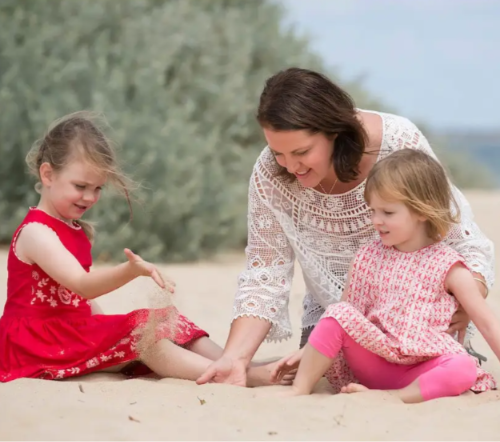

By Margaret Ambrose
My IVF specialist was all about advice, as doctors tend to be, and I followed it all to the letter, something I am really pleased I did – it led me to having my two beautiful daughters, Greta and Aurora. It had been a long and stressful, but ultimately joyous, relationship and, as I prepared to give birth to my first child, I was filled with mountains of respect for his medical know-how, as well as his kindness. Years later, though, it was his parting words to me that really stuck.
“Just remember,” he said, “if you are ever struggling, if you ever need support, you must reach out for help immediately.”
Yeah, yeah, yeah, I brushed it off. Struggling or needing support was the furthest thing from my mind – I was having a baby, all my dreams were coming true!
“Listen to me,” he said seriously. “All new mothers need support and depression is real, and what I have seen is that single mothers who have undergone IVF are often reluctant to ask for help.” Seeing the puzzled look on my face, he added: “They don’t want to ask for help because they think people are going to say, ‘Well, you asked for this.’”
There’s so much I can say about the awfulness of women believing that there are conditions attached to whether they deserve help, but the reason I am telling you this story is because of what I have learned about being a single mother by choice: We are single mothers, but we do face particular issues.
I always knew there were going to be issues around being a single mother by choice that I would have to deal with. How do I speak to my kids about being donor-conceived? How do I prepare them for potential stigma? How the hell do I get Centrelink to understand that there is no father to chase for child support because my daughters don’t actually have a father?? (I was one of the first single women to legally have my kids using IVF and donor conception when the laws in Victoria changed, and I believe that Centrelink has since wrapped its head around the concept, but sheesh!)
Yet, the truth is, at the time, while I knew I was a single mother, I didn’t feel like one. When I told people I was a single mum, the most frequent reaction I got was one of pity. Poor thing, raising those girls on your own with no help from a husband. Ignoring the pure misogyny of suggesting a woman who lives her life without a man must be sad, and ignoring the fact that, from what I could see from many of my partnered friends, their husbands were little help at all and actually brought with them extra work, I didn’t feel like a struggling single mother; I felt like I was living the dream.
I had been in my late 30s and undergoing IVF with my then-partner when the relationship broke down and we separated. I went to my next IVF appointment fully intending to tell my specialist that this was the end of my IVF journey, but when I told him what had happened, he told me that the laws had just changed in Victoria and that if I wanted, I could still become a mother. I would just need to swap out a partner for a donor.
There was no question in my mind that I would go ahead. I had always wanted to become a mother, and I had already invested a year in fertility treatment. With every failed attempt, my treatment plan had changed and been refined. This just felt like another change. It’s a decision I am forever thankful I made.
When Greta and Aurora were young, in my mind, there was a disconnect between me being a single mother and me being what I thought a single mother was. I knew I was a single mother, but I wasn’t what society told me a single mother should look like. I owned my house, I had a good job, and I was supported by family and friends.
When my youngest started school, I began working at the Council of Single Mothers and their Children, and it wasn’t long before I realised that there is no one ‘single mother’. I met single mothers struggling with systems that don’t recognise the reality of raising children on one income, while others were more financially secure. I saw single mothers living with the trauma of family violence, while others weren’t. I met single mothers who were educated professionals; others were tradeswomen, some were students, and others were not employed outside the home.
I began to see myself in the community of single mothers, with all our differences and unique experiences. We are different, but we’re the same.
This was made really clear to me when I joined the Australian Solo Mothers by Choice (ASMBC) Facebook group. I joined really just to connect with other single mums of donor-conceived kids. Maybe some of their stories could help inform the way I was raising my girls or help me better understand the complex legal issues that still surround assisted reproduction.
What I found was a vibrant, intelligent, engaged group of women, all with the shared goal of raising their beautiful kids. There were questions and answers around things like known versus anonymous donors, what to do with leftover embryos, and overseas IVF egg donation, but there were also issues discussed that were simply about being a mum, like how to deal with bullying, what cures nappy rash, and how do you date when you are this tired??
One of the most profound things I have learned about being a single mum is that, no matter our journey to motherhood, we’re all learning on the job. And one of the most impactful things I have learned is that accessing information, resources and support when we need it is the most powerful tool for that job.
If you are a single mother by choice, ARTFam (Assisted Reproductive Treatment Families Australia) is the best place for all things to do with IVF and donor conception. It’s a totally inclusive not-for-profit organisation dedicated to supporting, educating, connecting and advocating for donor recipient mums, donors, donor-conceived kids and everyone who has some involvement in assisted reproduction. It’s a great place to visit if you are a single mother by choice or are considering becoming one.
CSMC’s Support Line is also there for every single mother, no matter what our journey to becoming a single mother looks like. All the Support Line workers have the lived experience of being single mums, so they get it.
Some women who call CSMC’s Support Line are dealing with complex and serious issues; others are simply seeking answers to questions, but they all receive the support, referrals, information and resources they need from a Support Line Worker who provides validation, support and the opportunity to discuss the issues and evaluate options. Callers are provided with support that includes specialist, tailored information, referrals and emergency financial support.
Many of the callers are single mothers by choice, and CSMC’s Support Line Workers listen without judgement, so if you are in need of support, get in touch.
When I think of CSMC’s Support Line, I sometimes think of my IVF doctor’s words: “They don’t want to ask for help because they think people are going to say, ‘Well, you asked for this.’”
If I have any advice for single mothers by choice, it would be this: being a single mother doesn’t mean you are alone. All mothers are deserving of support, and together we are community.

0 Comments